
Why Greyhound Trial Races Are Excluded From Analysis
Trial races (T-grade) appear on UK cards but aren't competitive — they're solo runs for grading and qualification. Here's why ratethat.dog strips them from all analysis.
What is a greyhound trial race?
A trial — flagged as T-grade or 'Trial' on a UK racecard — isn't a competitive race. It's a solo run, or a small-field run, used to test fitness, qualify a dog for graded racing, or assess a dog returning from injury or layoff. Trials don't pay prize money in the way graded races do, and bookmakers typically don't price them.
On a card, T-grade races are usually scheduled before or after the main racing block. They're part of the venue's operations but not part of the betting picture.
Why doesn't ratethat.dog include trial races?
Because they're not predictive. A trial is a controlled environment — the dog runs without the pressure of competing for a race, often with no other dogs on the track or with a single pacemaker. The time recorded in a trial doesn't translate cleanly to race conditions.
Including trial times in the Performance Rating or Field Speed calculations would distort the model — making dogs look faster than they really are in race conditions, or smoothing out genuine recent form with neutral trial data.
How does ratethat.dog handle trials internally?
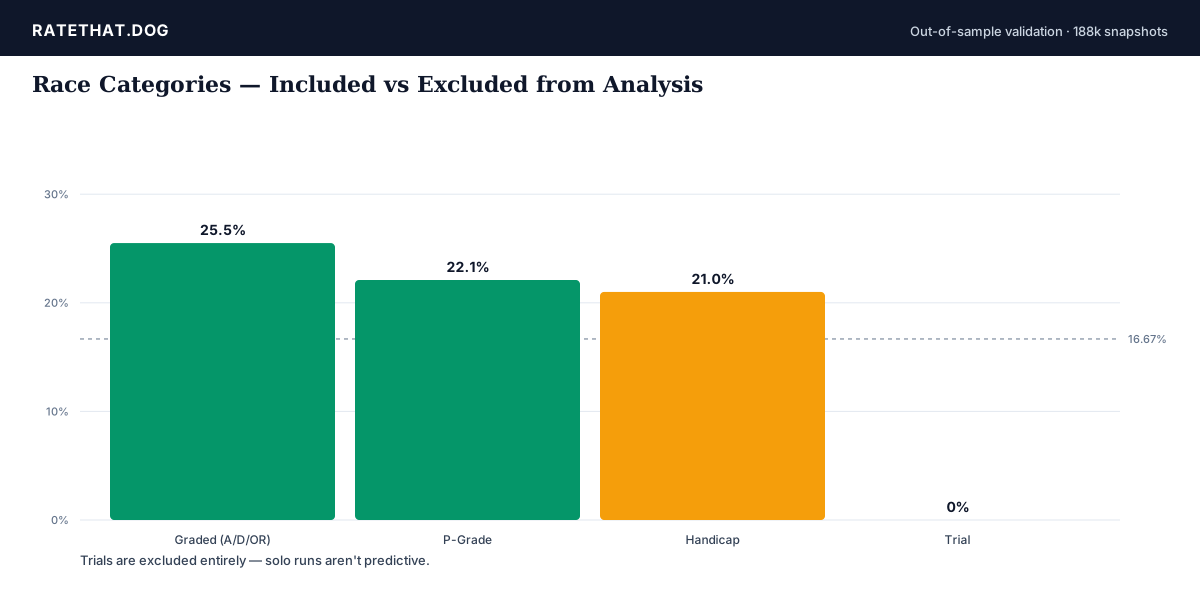
Trials are stripped from every analytical surface. They don't appear in the Hindsight accuracy metrics, they don't appear in Track Analysis trap-bias data, they don't feed into composite scores, and they don't qualify for Hot Dogs. The CLAUDE-spec for the platform explicitly excludes T-grade races from all model and reporting paths. If you specifically want to look at upcoming trial runs (for fitness-tracking or profile updates), the Trials page lists them separately.
This is a deliberate choice. Many other rating providers include trial times to bulk up their data; we don't, because we'd rather a smaller dataset that predicts cleanly than a larger one that's contaminated with non-race signal.
Can I bet on a trial race?
Sometimes — bookmakers occasionally price small-field trials on quiet betting days. We'd recommend against. The dogs aren't trying in the same way as in graded racing; the result can flip on a fitness whim that the form doesn't capture.
If you do bet trials, treat them as their own category with bigger variance and lower confidence. Don't include them in saved systems — the system's ROI numbers will be polluted by races that aren't really racing.
What about hindsight performance — should trials be there?
No. The Hindsight page is specifically about prediction-vs-actual on competitive races. Adding trial races would inflate the strike rate (most trial favourites win because they're often unopposed) without adding any real predictive insight. The page is more useful when filtered cleanly to graded racing — which is what we ship.
Frequently asked questions
What is a T-grade greyhound race?
A trial — a non-competitive solo or small-field run used for fitness testing, qualifying for graded racing, or assessing a dog returning from injury. Not part of the betting picture.
Why are trial races excluded from ratethat.dog?
Because trials aren't predictive of race performance. Including them would distort ratings and contaminate the model with non-race signal.
Can I bet on greyhound trials?
Occasionally bookmakers price small-field trials, but we'd recommend against. Trial behaviour is different from racing behaviour, and form doesn't translate.
Do trials count towards a dog's career stats?
On ratethat.dog, no — trials are excluded from all stats including suitability scores, career win rate, and form figures.
How do I tell a trial race from a graded race?
T-grade or 'Trial' marker next to the race grade on the card. Graded races use A-numbers (A1-A11), D-numbers (D1-D4), OR (Open Race) or P (Puppy).