
Build Your First Greyhound Betting System in 10 Minutes
A betting system is just a saved set of filters that picks dogs the same way every day. Here's how to build a useful one in ten minutes using ratethat.dog's Dog Selector.
What is a greyhound betting system?
A betting system is a saved set of rules — filters — that picks the same kind of dog every day, automatically. You write the rules once. The system finds the qualifying runners on every UK card from then on, and tracks the P&L so you know whether the rules actually work.
On ratethat.dog, systems live alongside the Dog Selector. You build with filters, save the result as a system, and the platform records every day's selections so you can audit strike rate and ROI without spreadsheets. For purely model-feature filters (composite ranks, suitability components, field speed), the System Builder lets you backtest against the historical snapshot dataset before going live.
What makes a good first system?
Three rules. One: keep it simple. Two or three filters is plenty — the more you stack, the smaller the daily sample, and small samples tell you nothing. Two: anchor it on a signal you trust. Composite score, trap bias, or a specific track are sturdy starting points; "dog whose name starts with B" is not. Three: make it produce 1-5 picks per day on average. Fewer than that and you'll wait weeks to learn anything; more than that and you're not really filtering.
How do I actually build one?
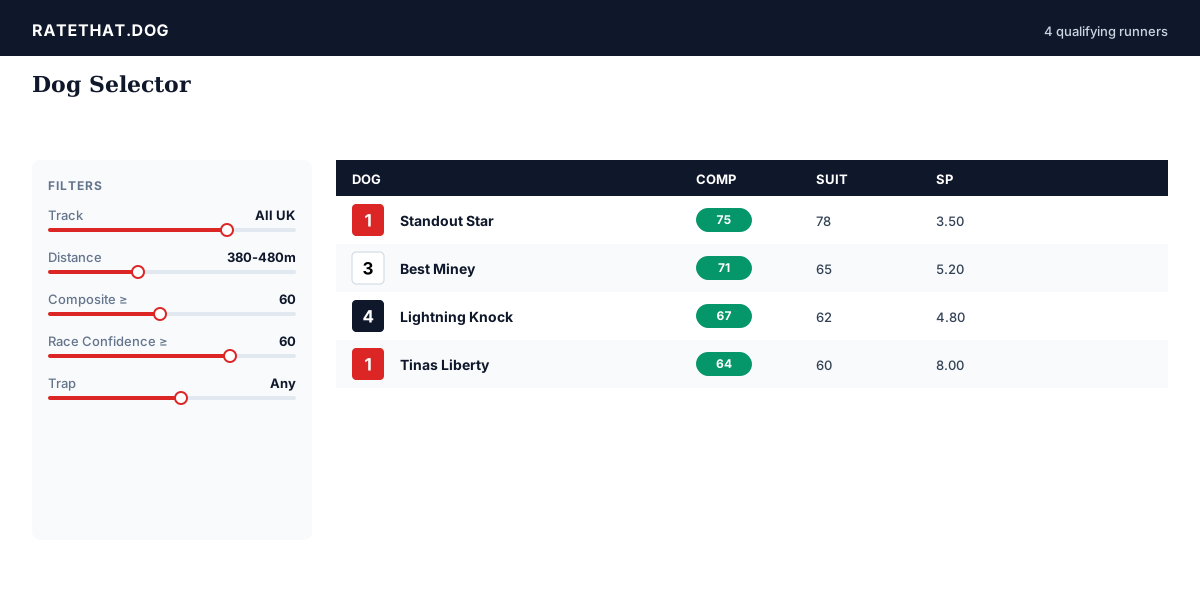
Open the Dog Selector and you'll see a long list of every UK runner today, alongside dozens of filter controls. Build in this order: filter to a specific track or grade band first (this constrains your sample to a single context); add the composite score filter (e.g. composite ≥ 60); add one differentiator (e.g. "top trap rank in race" or "top speed in field").
Watch the runner count update as you tighten. Aim for 1-5 dogs across the day. If you're getting 20, you haven't filtered enough. If you're getting 0 most days, your thresholds are too strict.
What are some good first-system templates?
- **Hove Trap 1 Composite**: filter track to Hove, distance to 500m, trap to 1, composite score ≥ 55. Stacks the most-biased trap in the UK with a strong rating.
- **Sprint Wide Trap**: track Harlow OR Central Park, distance under 300m, trap 5 or 6, composite score ≥ 50. Plays the sprint Trap 6 reversal.
- **Top Pick at Standard Distance**: distance 380-480m, composite rank in race = 1, gap to next composite ≥ 8. Backs the composite top pick only when the field falls away.
How do I save it and track P&L?
Once your filters are dialled in, hit save. Give the system a name (specific is better than clever — "Hove T1 Composite 55+" beats "My System"). The platform now records every day's qualifying picks and settles them when results come in.
On the Systems page you'll see strike rate, place rate, win/place P&L on level stakes, ROI%, and a daily breakdown. Give a new system at least 50-100 picks before you trust the numbers — anything less is noise.
When should I throw a system out?
Three signals. One: it produces no picks for two weeks straight — the filters are too strict and you're not learning anything. Two: ROI is below -10% over 100+ picks — the rules are losing meaningfully and tweaking won't save them. Three: the strike rate is fine but ROI is bad — you're picking decent dogs at terrible prices, and the market is more efficient than your filter.
Don't throw out a system on a 5-pick losing run. Greyhound racing has variance baked in; even a 28% strike-rate system loses 7 in a row sometimes. Patience beats panic.
Frequently asked questions
How many picks per day should a good greyhound system produce?
Aim for 1-5 picks across the full UK card. Fewer than that and you'll wait weeks to learn whether the rules work; more than that and you're not really filtering down to an edge.
How long before a betting system tells me anything reliable?
Around 50-100 settled picks. Less than 50 is noise. After 100, ROI and strike rate start to converge on the system's true performance.
Can I run multiple systems at once?
Yes. Save as many as you like — the platform tracks each independently. Some bettors run 3-5 systems covering different tracks, distances or signals.
What's the difference between a Dog Selector system and an ML system?
Dog Selector systems filter on live runner data (form, trainer, trap). ML systems filter on the model's prediction features (composite, suitability, field speed ranks). We've covered the difference in detail in the ML vs DS comparison.
Do I need to bet every pick the system makes?
If you want the recorded ROI to match your real ROI, yes. Cherry-picking from a system on instinct usually erodes the edge — the strike rate is calculated assuming you back them all on level stakes.