

Why Greyhound Sprint Tracks Reward Trap 6 (Not Trap 1) — The UK Data
At standard distances Trap 1 dominates UK greyhound racing. At sprint distances, the logic flips — Trap 6 wins more often. Here's where it happens, why, and how to bet sprints differently.
What is the short-sprint trap reversal?
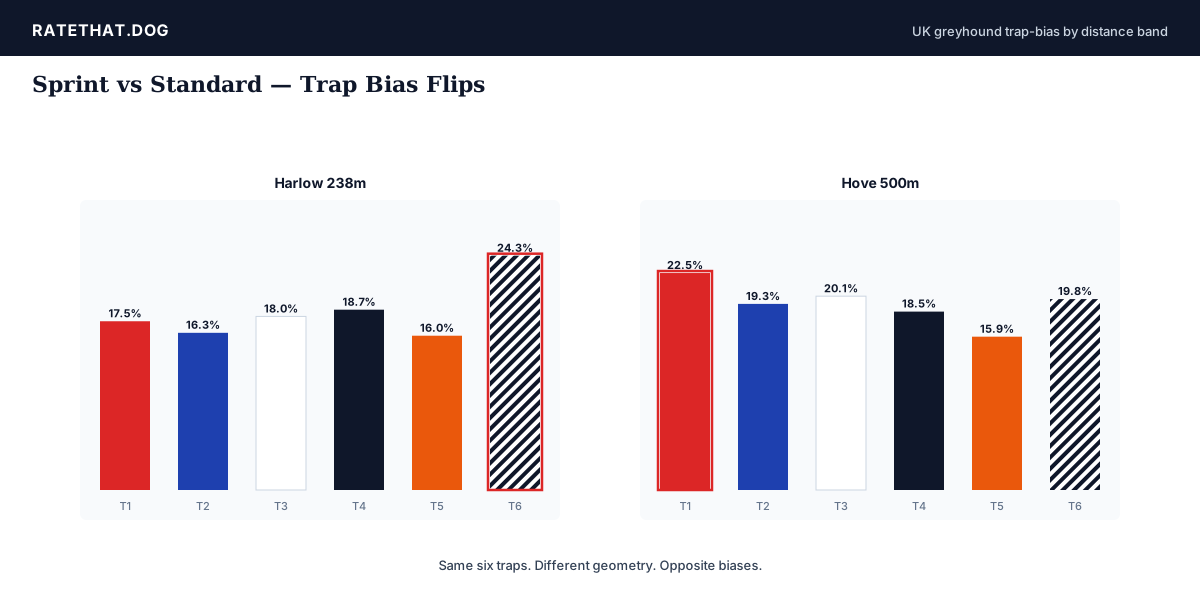
Across most UK greyhound tracks at standard distances (380-500m), Trap 1 is the dominant winning trap — the rail position gives the inside dog a clear path to the first bend. At short sprint distances (under 300m), that logic breaks. Trap 6 — the widest draw — wins more often than Trap 1.
It's not subtle. Across nearly 25,000 settled sprint runs at the two biggest UK sprint tracks, Trap 6 wins at rates that would be considered strong even at a standard-distance Trap 1 venue.
Where does the Trap 6 sprint bias actually happen?
Two tracks lead the data. **Harlow at 238m: Trap 6 wins 24.3%** of races over 14,833 runs, while Trap 1 wins just 17.5%. **Central Park at 277m: Trap 6 wins 22.1%** of races over 9,624 runs, while Trap 1 wins 16.6%.
Both tracks are sprint specialists where the first bend arrives so soon after the start that the rail dog never gets to settle. The wide trap, drawn outside the early traffic, is the cleanest position. The pattern repeats at other short-distance circuits — Doncaster's 450m sees Trap 6 win 23.8% — though the strongest signals are at the truly short sprints.
Why does the wide trap win short sprints?
Three things going on. First, geometry: at 238m or 277m, the first bend isn't a long way off — it arrives almost immediately. Trap 1's rail advantage hasn't had time to compound by the time the dogs reach it; the rail dog can be squeezed by Trap 2 or 3 breaking faster. Second, traffic: the inside three traps fight for the same line; the wide trap runs in clean air. Third, draw quality: trainers who own genuinely fast sprinters often choose to draw them wide deliberately, knowing the trap signal favours it.
The result: sprint tracks reward dogs that come off the trap fast and have running room, not dogs that grind out a rail-saving inside line.
How do I bet short-sprint races differently?
Two practical changes. One: invert the trap-bias logic. At Harlow 238m or Central Park 277m, a top composite-score dog drawn in Trap 6 is a stronger position than the same dog drawn in Trap 1 — the opposite of how you'd think at Hove or Monmore. Two: discount form figures from longer distances. A dog stepping down from 480m to a 238m sprint isn't necessarily prepared; sprint racing is a different skill set, and recent sprint form is far more useful than recent middle-distance form.
The Dog Selector lets you filter to specific tracks and distances — set Harlow 238m, sort by composite score, and pay extra attention to whatever is drawn in Traps 4-6.
Are there any sprint tracks where Trap 1 still wins?
Yes — not all sprints flip the logic completely. At standard 380-450m races there's still typically a Trap 1 edge, with the wide trap profile only really kicking in below ~300m. And even at sprint specialist tracks, the bias is a bias — not a rule. A weak Trap 6 in a sprint will still get beaten by a strong Trap 1 with a higher composite score.
The takeaway: distance band matters more than the track when reading trap bias. Always look at the specific distance you're betting on, not just the venue name.
Frequently asked questions
What is the best trap in greyhound sprints?
Trap 6 at the shortest sprint distances. Harlow 238m: Trap 6 wins 24.3%. Central Park 277m: Trap 6 wins 22.1%. The wide trap gets clean running into a quick first bend.
Why doesn't Trap 1 win greyhound sprints?
The first bend arrives too quickly for Trap 1's rail advantage to compound. The inside traps fight for the same line, while the wide trap runs in clean air into the bend.
What counts as a sprint distance in UK greyhound racing?
Generally races under 300m. The strongest Trap 6 sprint bias appears at 238m (Harlow) and 277m (Central Park).
Can I use middle-distance form to predict sprint races?
With caution. Sprint racing is a different skill — first-bend speed and clean running matter much more than stamina or pace judgement. Recent sprint-distance form is far more reliable than form from longer races.
Where can I see sprint-specific trap-bias data?
On the Track Analysis pages for sprint-specialist tracks like Harlow and Central Park. The trap-bias breakdowns are split by distance, so you can see the sprint profile separately from any longer races run at the same venue.