

What is Field Speed Rating? The Greyhound Metric That Lifts Standard-Distance Picks to 25.8%
Field Speed Rating is the per-race adjusted run-time score that drives ratethat.dog's standard-distance composite. It's why top picks at 380-480m hit at 25.8% — here's how it works.
What is Field Speed Rating?
Field Speed Rating is a per-race score that compares each runner's recent adjusted run times against the dogs they're racing today. It's centred on 50 — meaning the field average is always 50 — with strong dogs scoring 60-70 and weak dogs in the 30-40 range.
Unlike a raw speed figure, Field Speed isn't about absolute pace; it's about who's faster than today's specific opponents. That makes it directly useful for picking races, rather than picking dogs in the abstract.
How is Field Speed calculated?
Each dog's recent run times are adjusted for distance, going (track conditions on the day), and grade context — so a 28.5s 480m run on a fast track at A1 isn't compared with a 28.5s 480m run on a slow track at A8. Once adjusted, the times are ranked relative to the other runners in today's race and rescaled around 50.
Critically, the rating updates per race. The same dog can have a Field Speed of 65 in one card (if today's field is weak) and 45 in another (if today's field is strong). The number tells you how the dog stacks up against the dogs it actually has to beat.
Why is Field Speed so important at standard distance?
Because run times are the cleanest signal at 380-480m, where the lap is long enough for class and form gaps to play out fully. At sprint distances, the race is decided in the first three seconds and time means less; at marathon distances, sample sizes shrink. Standard distance is where Field Speed earns its keep.
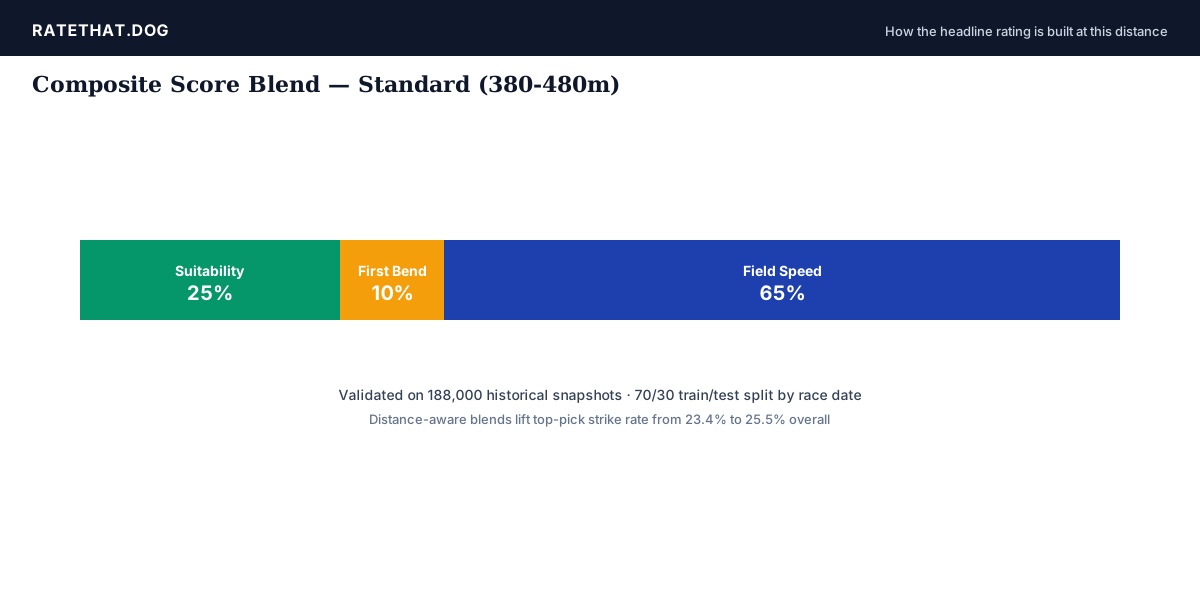
In our composite score validation, the standard-distance blend is **65% Field Speed** — by far the heaviest weight. That's not a guess; it's what 188,000 historical pre-race snapshots said performed best. The shift from the legacy model (which leaned on raw performance) to a Field-Speed-led standard blend lifted top-pick strike rate from 22.6% to 25.8%.
How do I use Field Speed in a system?
Two clean filters. **Top Field Speed in race** surfaces every race's fastest projected runner — a strong starting point at 380-480m. **Field Speed ≥ 60** finds dogs meaningfully above field average; combine with composite for higher conviction.
Don't use Field Speed alone at sprint distances. The sprint composite blend weights performance heavily and Field Speed only at 0% — meaning Field Speed at 270m is informational, not predictive. Always check the distance band before relying on this metric.
How is Field Speed different from a raw speed figure?
Raw speed figures (often called speed ratings) try to express "how fast is this dog in absolute terms". They're useful for cross-track comparison but don't tell you who's likely to win today's specific race. Field Speed throws absolute pace away and asks the only question that matters: who is fastest in this field, today, on these conditions.
It's a smaller question than "how fast is this dog" — but it's the right question for picking a winner.
Frequently asked questions
What is Field Speed Rating in greyhound racing?
A per-race rating that compares each dog's adjusted recent run times against the rest of today's field. Centred on 50 (field average), with strong dogs scoring 60-70 and weak dogs 30-40.
How is Field Speed different from a speed rating?
Speed ratings give absolute pace; Field Speed gives relative pace within today's race. Field Speed is more directly useful for picking winners because it answers the only question that matters: who's fastest of these specific six dogs.
What weight does Field Speed have in the composite score?
It varies by distance. At standard distance (380-480m) it's 65% — the dominant signal. At sprints (under 380m) it's 0%. At long distances (480-600m) it's 50%.
Can I filter on Field Speed in the Dog Selector?
Yes. Both raw Field Speed and Field Speed rank in race are filterable. "Top Field Speed in race" is one of the strongest single-filter starts at standard distance.
Why is the standard-distance Field Speed weight so high?
Because the data said so. In the 70/30 out-of-sample test on 188,000 snapshots, weighting Field Speed at 65% produced the best top-pick strike rate at standard distance — lifting from 22.6% to 25.8%.