
Green Flags in a Greyhound Racecard — The Six Signals That Compound
Some bets get stronger the deeper you look. Here are the six green flags on a greyhound racecard that turn a good pick into a great one — the signals that quietly compound.
What's a green flag in a greyhound race?
A green flag is a feature of the race or the dog that increases the chance of a confident pick translating into a win. Like red flags, green flags don't replace your rating-based analysis — they sit on top of it. A composite top pick with three green flags is a much stronger bet than the same dog with none.
Green flags are the quiet signals that the rating may have weighted but not fully expressed. Spotting them is one of the cleanest MOF-tier edges in greyhound betting.
Green flag #1: improving sectional times
Sectional times that have been getting faster over the last 3-4 runs signal a dog on the up. Even if the form figures don't yet show wins, the sectional trend says the dog is closing in on a result. The model picks up on this through the Performance Rating's sectional progression component (15% weight), but a manual check still adds confidence.
Look for a sequence like 3.62 → 3.59 → 3.55 over consecutive runs at the same track and distance. That's a dog about to convert.
Green flag #2: weight loss since last run
A dog that's lost 0.3-0.8kg since its last run has typically tightened up — leaner dogs are faster. Trainers often run a dog slightly heavier early in a campaign and trim them down for the target races; weight loss between runs usually signals the trainer believes the dog is ready.
Larger losses (1.5kg+) can be a red flag instead — the dog may be off form or unwell. Look for moderate, deliberate-looking weight movements.
Green flag #3: optimal rest period (6-14 days)
Greyhound research suggests 6-14 days is the sweet spot between runs — long enough to recover, short enough to retain fitness. Dogs in this rest band tend to outperform dogs returning sooner (potentially still tired) or after longer breaks (sharpness fades).
On ratethat.dog the dog profile shows days since last run; check the column when you're on the fence about a pick. A 9-day-rested top composite is a stronger position than a 21-day-rested one.
Green flag #4: dominant trap at this venue
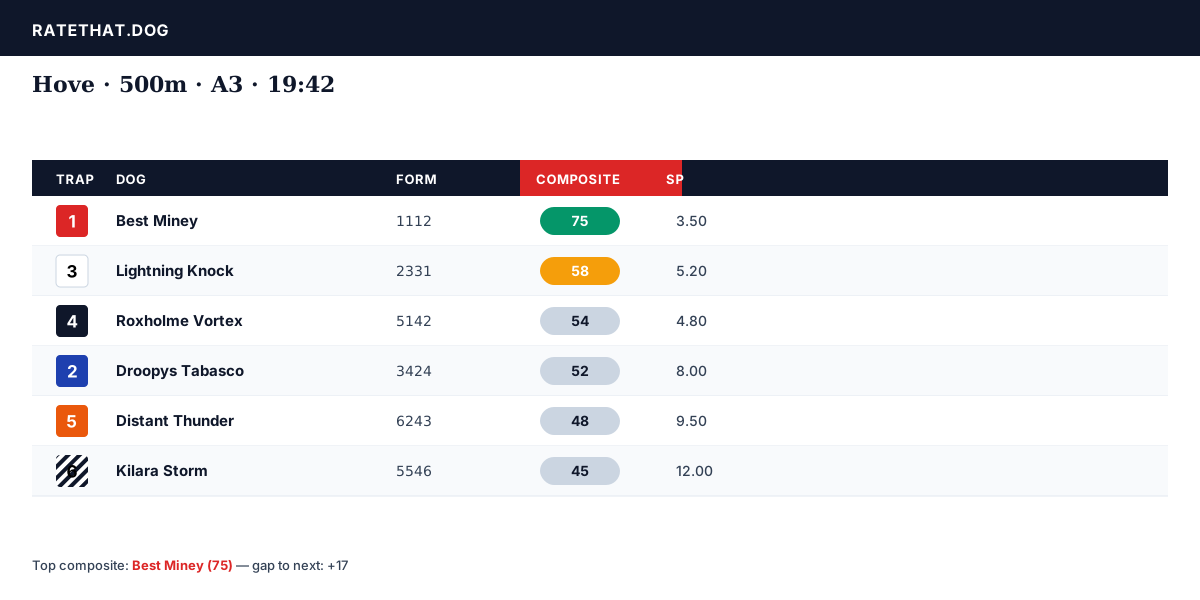
When the model's top composite pick is also drawn in the historically dominant trap at the venue and distance, that's a structural green flag. Hove 500m Trap 1, Monmore 480m Trap 1, Yarmouth 462m Trap 3, Harlow 238m Trap 6 — these are all positions where the geometry compounds the rating.
It's not double-counting; the rating already partially weights trap suitability, but the bias from a venue-specific draw is sharper than the average suitability score captures.
Green flag #5: trainer in current form
A trainer running 25%+ over the last 14 days — well above the UK trainer average of 14-16% — is in form. When a top composite pick is also a hot-trainer dog, the kennel signal compounds the rating. We covered this in detail in the trainer form guide.
The market is slow to react to trainer form, particularly in the first 1-2 weeks of a streak. Hot-trainer top picks at fair prices are one of the cleanest value angles available.
Green flag #6: high race confidence
Race Confidence above 70 is a green flag in itself. The race is the kind of race a top pick is likely to win in — clean grading, strong track-distance profile, meaningful composite gap, no handicap penalty. Combine with any of the other five green flags and you've got a high-conviction position. The model's strongest combined signals each day surface on Strong Picks.
The combo to look for: composite top pick + improving sectionals + dominant trap + high race confidence. That stack of four green flags is a Hot-Dog-tier signal even when the formal Hot Dog filter doesn't trigger.
Frequently asked questions
How many green flags should I want on a greyhound bet?
Two or more is genuinely strong. Three or more is high-conviction territory. Even one green flag adds meaningful confidence over a vanilla composite top pick.
What's the strongest single green flag?
High race confidence (above 70) is the broadest signal — it captures grade, track profile and composite gap in one number. After that, dominant trap-venue match and improving sectionals are the sharpest individual signals.
Where do I see green flags on ratethat.dog?
On every race page. Green flag badges appear on each runner alongside the composite score and red flag badges. The Dog Selector lets you filter by green-flag count.
Can a dog have green flags AND red flags?
Yes — many dogs do. The net signal is what matters. A dog with three green flags and one red flag is still a strong pick; a dog with one green and three reds usually isn't.
Are green flags the same as Hot Dog signals?
Related but stricter. Hot Dogs require a composite ≥ 60 with no rival above the threshold. Green flags are a broader confidence indicator — a dog can carry green flags without qualifying as a Hot Dog.