
Why Greyhound Favourites Lose 60-65% of the Time (And What to Look For Instead)
Backing every favourite blind is a losing strategy in greyhound racing — they win only 30-35% of the time. Here's why, and what tells you when a favourite is actually worth the price.
How often do greyhound favourites win?
About 30-35% of the time across UK racing. The exact number depends on grade and distance — favourites in higher grades (A1, OR) win closer to 35%; favourites in lower grades (A8-A11, D3-D4) closer to 28-30%. Either way, the headline takeaway is the same: **the market favourite loses around two-thirds of all races**.
Backing every favourite blind on level stakes is a slow loss. Even at 33% strike rate, average SPs of 2.5-2.8 don't return enough to offset the 67% loss rate. The market is broadly efficient at picking out the strongest dog; what it's not great at is paying you fair odds for backing it.
Why don't greyhound favourites win more?
Three structural reasons. **One: greyhound racing is messy.** Six dogs into a tight first bend creates traffic, bumping and crowding. Even a clear best dog can get squeezed and lose meaningful ground. **Two: short race distances mean short windows to recover.** A bad break is much harder to overcome in 30 seconds than in three minutes of horse racing. **Three: the field is closer than you think.** A six-dog field where Dog A is 'best' usually means Dog A is 25% to win — the other five share the remaining 75%. That's not the same as 'Dog A wins'.
Fundamentally, the question isn't whether favourites are good dogs — they usually are. The question is whether the price the market is offering covers the true probability. Often it doesn't.
How do I know when a favourite is worth backing?
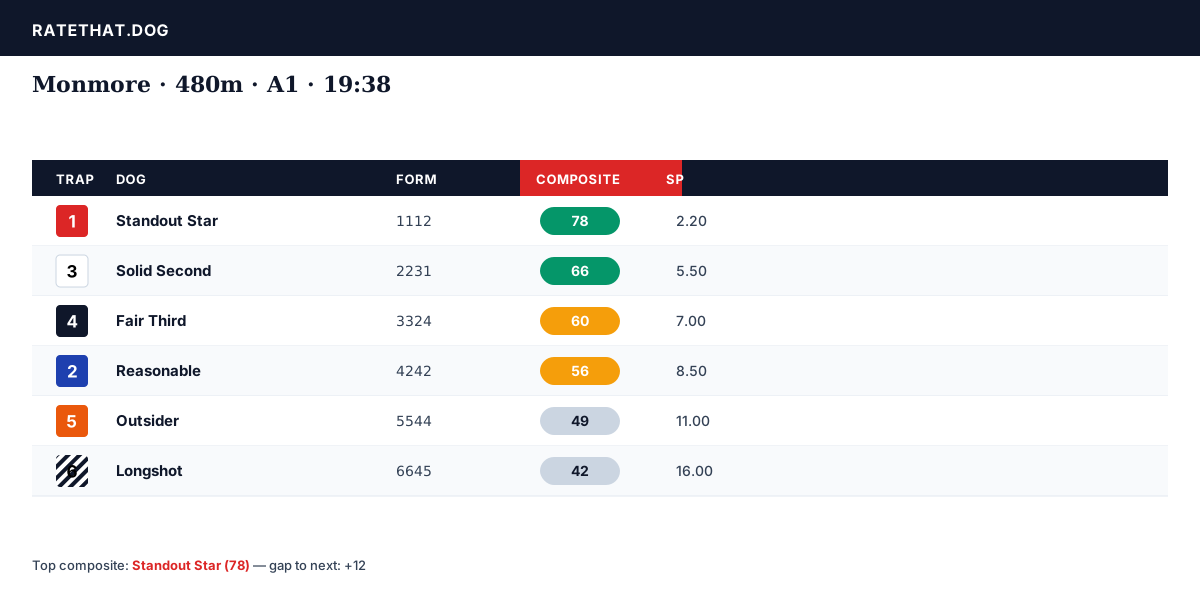
The single best signal is the **composite-score gap**. If the market favourite is also the composite top pick AND the gap to the second-best composite in the field is 8+ points, you're looking at a genuinely standout dog. That's the same shape that produces a Hot Dog — a 28.34% strike-rate signal.
If the market favourite is the composite top pick by a small gap (1-3 points), the model's edge is much weaker — and the price is often too short to be worth taking. If the favourite isn't even the composite top pick, the market is paying for something the data doesn't see — usually a recent eye-catching run that doesn't translate.
What should I look for instead of just backing favourites?
- **Composite top picks at value prices** — particularly when the SP is 4.0+. Same strike rate, much better long-run ROI than short-priced favourites.
- **Hot Dogs** — composite-60+ runners with no obvious rival. 28.34% strike rate, often available at 3.5-5.0 SP.
- **Trap-bias matches** — favourites that happen to be drawn in the dominant trap at the venue. The bias compounds the rating into a stronger position.
- **Race-confidence races** — back the favourite (or top pick) only when Race Confidence is high. In low-confidence races, even the strongest dog underperforms.
Should I lay favourites in greyhound racing?
It's a viable angle if you have access to an exchange. Laying every favourite blind would slowly profit on the market's over-pricing of short prices — but the variance is high, and the platform fees eat a chunk of the edge.
A more focused approach: lay favourites only in races where the Race Confidence is below 50, the favourite is short-priced (under 2.5 SP), and the composite gap is small. Those are the races where the market's confidence outruns the data.
Frequently asked questions
How often does the favourite win in greyhound racing?
30-35% of races, depending on grade and distance. Favourites in higher grades (A1, OR) win closer to 35%; lower grades closer to 28-30%.
Is it profitable to back greyhound favourites?
No, not blindly. At 30-35% strike rate and average SPs of 2.5-2.8, level-stakes favourite-backing produces a slow loss. Specific filters (composite top pick + big gap, high race confidence) can flip that.
Why are short-priced favourites bad value?
Because the market shortens the price faster than the strike rate justifies. A 2.0 SP favourite needs to win 50%+ to break even — most greyhound favourites don't.
Are favourites more reliable in higher grades?
Yes, marginally. A1 and OR races have more consistent dogs, and the favourite is usually a clearer cut above. Strike rates climb a few percentage points relative to lower grades.
What's a better signal than the favourite?
The composite top pick with a meaningful gap to the second-best. That signal hits at 25.5% all distances, 25.8% at standard distance, and goes to 28.34% in the Hot Dogs filter. The market often hasn't fully priced these in, especially the larger gaps.