
How to Bet Greyhound Puppy (P-Grade) Races — A Practical Guide
P-grade is the puppy class — young dogs still building their form record. Here's how to bet P-grade races sensibly when sample sizes are small and form is still forming.
What is a P-grade greyhound race?
P-grade — sometimes shown on cards as 'Puppy' or 'P' — is the grading category for young greyhounds, typically under 24 months old, who are still building their racing record. P-grade races sit slightly outside the standard A-grade and D-grade ladders because the dogs in them are establishing form rather than confirming it.
On a UK racecard, the P-grade marker appears next to the race grade. P races are run at standard distances and sprint distances depending on the venue.
Why is P-grade betting harder?
Two reasons. **One:** small samples. A puppy may have run 4-8 races total before hitting P-grade — not enough to build a reliable suitability score, sectional progression trend, or trap record. The model rates them, but with less confidence than a dog with 30+ runs.
**Two:** rapid improvement. Puppies are still physically maturing and learning race tactics. A dog that finished 5th in its last P-grade run might win the next one not because of any visible signal, but because it grew into the race. That kind of jump is hard to predict from form alone.
What signals work in P-grade?
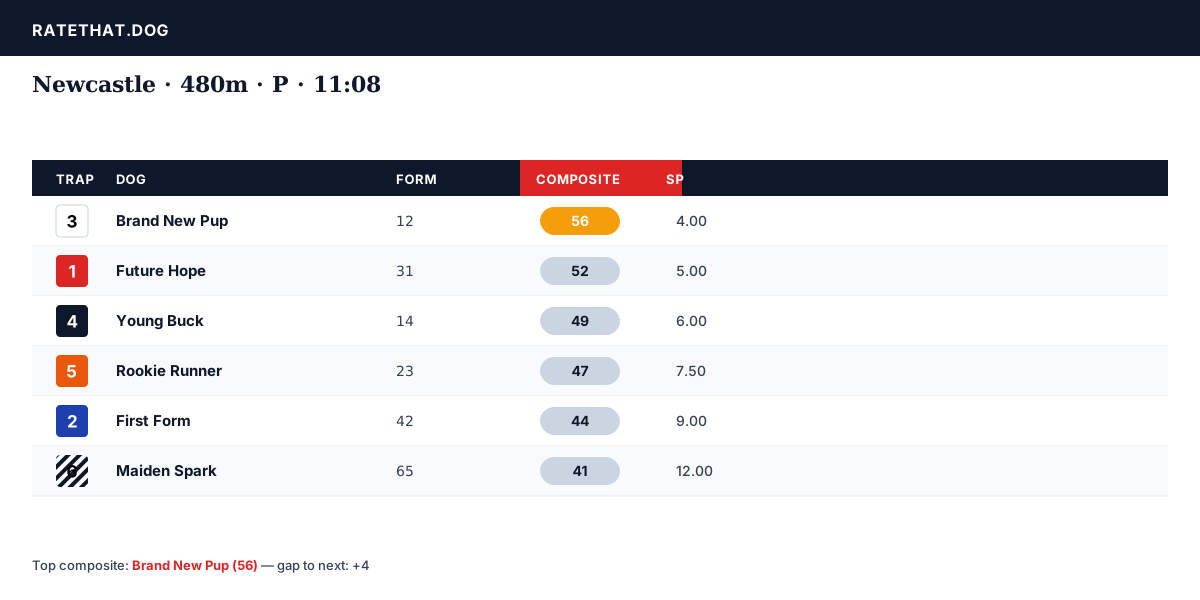
**Sectional times beat finishing positions.** A puppy with fast first sectionals — even from poor finishing positions — is signalling speed. The form figure may say 5-4-6, but if the sectionals say 3.55-3.52-3.49 (improving), the dog is on the way to a win. We covered the approach in the sectional times piece.
**Bloodlines matter more than usual.** Sire and dam records can give you a prior on what kind of racer the puppy will become — fast starters, stayers, sprint specialists. The Sires & Dams page lets you trace bloodlines directly, and the Dogs database shows parental records on each individual dog profile.
**Trainer specialism matters.** Some trainers focus on developing puppies (and have track records of producing winners early); others focus on adult campaigners. A puppy in a known puppy-development kennel is a different proposition.
What signals don't work in P-grade?
**Track-distance suitability** — the dog hasn't run enough times at any condition to have a reliable suitability score. The model knows this and weights suitability lower for low-sample dogs, but you should be aware that the headline composite is leaning more on speed and form than usual.
**Form figures alone** — "1234" over 4 races at P-grade means very little compared to the same form over 20 races at A-grade. Look at the underlying sectionals, not just the finishes.
How should I size P-grade bets?
Smaller than usual. The variance is higher because the predictions are less confident. A standard 1-2% bankroll unit on a P-grade pick should probably be 0.5-1% — half-size to reflect the additional uncertainty.
If you're building a system, it's reasonable to exclude P-grade entirely until you have a specific filter that's proven to work in the category. The system you'd run on A-grade racing is unlikely to read P-grade as reliably.
Frequently asked questions
What does P-grade mean in greyhound racing?
P stands for Puppy — the category for young greyhounds (typically under 24 months) still establishing their racing record. P-grade races sit outside the standard A and D-grade ladders.
Are P-grade races harder to bet than A-grade?
Yes. Smaller sample sizes per dog, rapid physical improvement, and less reliable suitability scores all add uncertainty. Stake sizes should be smaller than for established-grade racing.
What's the most reliable signal in P-grade racing?
Sectional times — particularly sectional progression. A puppy's first-bend speed signals raw ability before the form figures can catch up.
Should I include P-grade races in a betting system?
Generally no — at least not until you have a P-specific filter. Most systems built on A-grade signals don't read P-grade reliably.
Do bloodlines matter for greyhound puppies?
More than for established dogs. Sire and dam records give a prior on what kind of racer the puppy will become — fast starter, stayer, sprint specialist. Worth checking on the dog profile page.