

Hove Greyhound Track Focus — Why Trap 1 Wins 22.5% of 500m Races
Hove is one of the most predictable greyhound tracks in the UK at its main 500m distance. Here's the trap-by-trap breakdown, the dominant running style, and three angles to bet Hove well.
What's special about Hove greyhound stadium?
Hove (often listed as Coral Hove) is a south-coast greyhound venue with one of the cleanest trap-bias signatures in the UK. Across 15,428 runs at the main 500m distance, Trap 1 wins 22.5% of races — well clear of the 16.67% baseline. That's not a small-sample fluke; it's one of the most reliable single-track edges we publish.
Hove also runs sprints at 285m and longer races at 740m, with their own trap profiles. But the 500m is the bread and butter — and the easiest distance to handicap.
Why does Trap 1 dominate at Hove 500m?
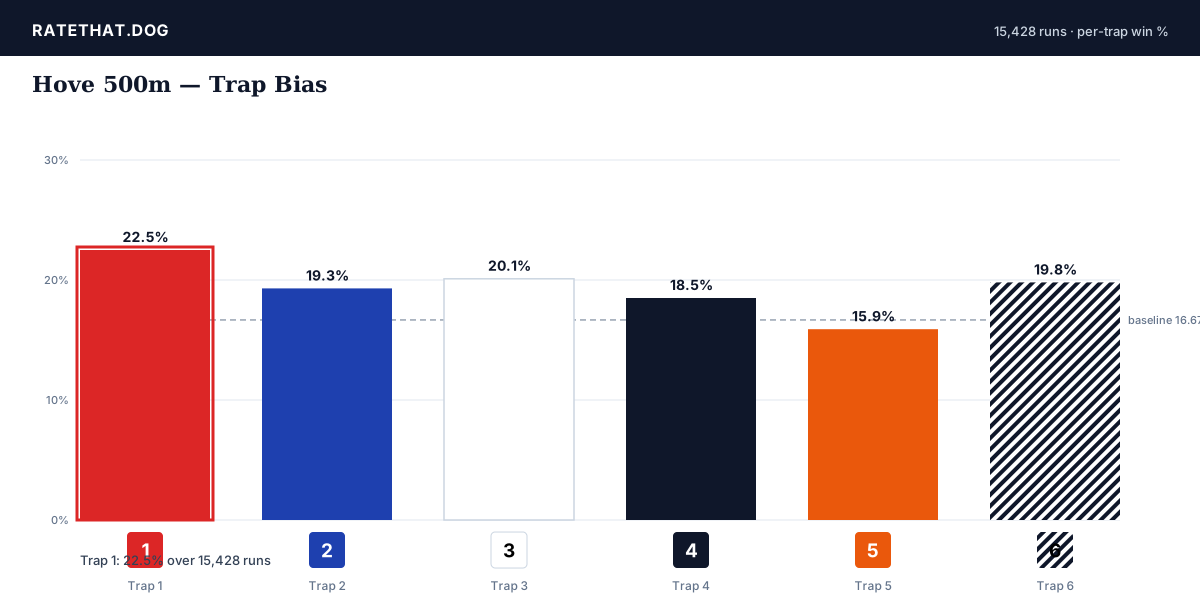
Track geometry. The 500m start at Hove gives Trap 1 a relatively quick run to a tight first bend, on the rail. The dog drawn closest to the rail gets there first, takes the racing line, and forces the wider runners either to go around (losing ground) or wait for a gap (losing position). That advantage compounds across thousands of races into a 5.8 percentage point edge over the baseline.
Crucially, the bias is consistent across grades. It's not a quirk of one division — Hove 500m Trap 1 has an edge in A1, A4 and A8 alike. That makes it actionable: you don't need to memorise grade-specific exceptions.
Which Hove distances should I focus on?
If you're learning the venue, start with the 500m. It's the most-run distance, has the strongest trap signal, and the form lines are reliable because you're comparing dogs across a single profile.
The 285m sprint is messier — sprints across the UK favour the wider trap, and Hove is no exception. The 740m marathon has small samples and is harder to trust without serious form-reading. Stick with 500m and you'll cover the bulk of Hove's racing with the cleanest signal.
How should I bet at Hove?
Three angles work consistently. One: filter the Dog Selector to Hove 500m, sort by composite score, and look for top picks drawn in Trap 1 — that combo is a hard-to-beat starting position. Two: when the top composite is in Trap 5 or 6 at Hove 500m, downgrade your confidence — the trap is fighting against the dog, even if the rating is high. Three: cross-reference with the trainer column. Hove has a stable of in-form trainers who know how to draw runs out of dogs at this venue.
ratethat.dog/track/Hove has the full per-distance, per-trap breakdown alongside live cards. The cross-venue comparison view lives on Track Data, and the venue's in-form trainers sit on Trainer Stats.
What's the historical edge if I just back Trap 1 at Hove 500m?
Across 15,428 settled runs at Hove 500m, Trap 1 wins 22.5% of races. Backing every Trap 1 blind on level stakes wouldn't produce a steady positive ROI on its own — the market knows about the bias and prices Trap 1 dogs accordingly. But the bias does mean: a Hove 500m Trap 1 with a top composite score and good current form is one of the strongest combinations on any UK card.
The edge is in the combination, not the trap alone. Use the trap as a confidence filter on top of the composite score — not as a standalone selection.
Frequently asked questions
What's the best trap at Hove?
Trap 1 at the 500m main distance, where it wins 22.5% of races over 15,428 runs — well above the 16.67% baseline.
What distances do they race at Hove?
Hove runs sprints at 285m, the main middle distance at 500m, and longer races at 740m. The 500m is the most-raced and most-predictable distance.
Is Hove a good track for beginners?
Yes. The strong, consistent Trap 1 bias at 500m makes the venue easier to handicap than tracks with flatter trap profiles. Form lines also tend to be reliable across grades.
Where can I see live Hove racing data on ratethat.dog?
On the Hove track page. It shows per-distance trap breakdowns, recent meetings, and links through to today's Hove racecards.
Does Trap 1 always win at Hove 500m?
No — Trap 1 wins 22.5% of races, which means it loses 77.5% of the time. The bias is strong relative to baseline, but it's not a guarantee. Use it as one input alongside composite score and form, not as a sole reason to back a dog.