
How to Find Value in Greyhound Betting — Using Ratings the Right Way
Value isn't picking winners — it's picking dogs whose prices are bigger than their true chance. Here's how to use ratethat.dog's ratings to spot value bets the market has mispriced.
What does "value" actually mean in greyhound betting?
Value is when the price you're getting is bigger than the dog's true chance of winning. If a dog has a 30% chance of winning, fair odds are 3.33 (1 / 0.30). Anything above 3.33 is value; anything below 3.33 is overpriced. Picking value bets is a different skill from picking winners — you can win a bet that wasn't value, and lose a bet that was.
Long-term, only value bets profit. A 25% strike rate at average 5.0 SP returns money. A 35% strike rate at average 2.5 SP loses money. Strike rate alone isn't enough.
How do I use ratings to spot value?
The composite score on every ratethat.dog racecard is, in effect, a probability estimate. The top dog's composite score doesn't translate to a percentage directly — but the **gap between the top dog and the rest of the field** does indicate confidence. A 12-point gap signals roughly 28-32% true win probability; a 2-point gap signals closer to 22%.
Value emerges when the market disagrees. If the model thinks a dog is 30% to win (composite top pick with a wide gap) and the SP is 6.0 — implying the market thinks 16.7% — you've got value. The opposite is also true: if the model thinks a dog is 18% but the SP is 3.0 — implying 33% — the market's overpaying.
What does a value bet actually look like?
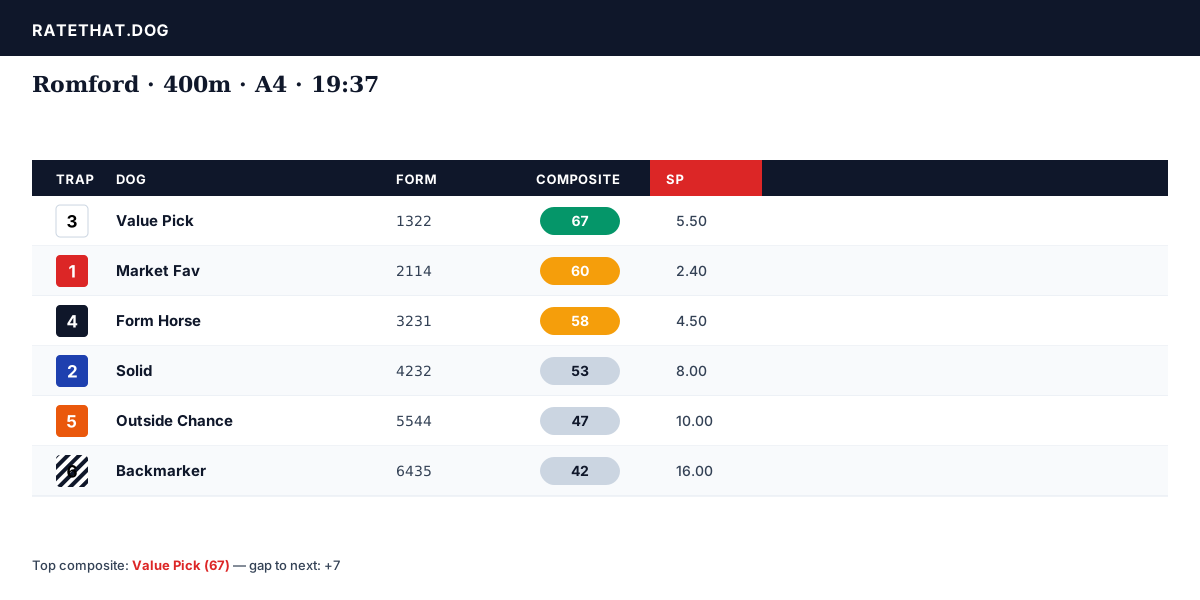
Three concrete shapes. **Shape one: composite top pick at 4.0+ SP.** The market often under-rates the model on dogs that don't have eye-catching recent form but rate strongly on suitability and field speed. **Shape two: Hot Dog at 4.5+ SP.** Hot Dogs hit 28.34%; fair odds are around 3.5. Anything above that is value.
**Shape three: trap-bias mismatch.** When a top composite dog is drawn in the dominant trap at the venue, but the market hasn't priced the trap edge in. "Composite 65 in Trap 1 at Hove 500m at 4.5 SP" is a recurring shape that the market often misses.
What's the most common value-betting mistake?
Confusing value with longshots. A 12.0 SP dog isn't value just because it's a longshot — it might genuinely be 8% to win, in which case 12.0 SP is fair, not generous. Value requires you to estimate the true probability, then compare to the market's price.
The fix: anchor on a model that gives you probability estimates rather than betting on instinct. The composite score, race confidence and rating gaps on ratethat.dog all express confidence in machine-readable form. Use them as the truth check on what the market is offering.
How do I track whether I'm finding value?
Track ROI, not strike rate. After 100+ bets, your ROI tells you whether you're picking value: positive = yes, flat = breakeven, negative = no. Strike rate is interesting but secondary — a 22% strike rate at long prices can be hugely profitable; a 40% strike rate at short prices can be a slow loss. The Probabilities page shows the model's implied chance for every runner side-by-side with the market — useful when sniffing for value mismatches.
Save your shortlist as a system and let the platform track the ROI for you. The numbers don't lie, and they cure instinct-based decision-making fast.
Frequently asked questions
What is value in greyhound betting?
Value is when the odds offered are bigger than the dog's true chance of winning. A 30% chance at 4.0 SP is value; the same 30% chance at 2.5 SP isn't.
Can I find value just by following the favourite?
Rarely. Favourites are usually short-priced enough that even a 35% strike rate doesn't profit. Value tends to come from dogs slightly outside the top of the market — composite top picks at 4.0+ SP are a common shape.
Is a 10.0 SP longshot value?
Only if its true chance of winning is greater than 1/10 (10%). Most longshots are longshots for good reason; backing them blindly because they're cheap loses money.
What's a good ROI for a value-betting greyhound system?
+5% to +15% over 100+ bets is genuinely profitable. Above +15% sustained is rare and usually signals a small sample or a fluke; below +5% may not survive future market efficiency improvements.
Where does ratethat.dog show value bets directly?
Strong Picks surfaces ratings-vs-market mismatches. The Dog Selector lets you stack composite-rank and SP filters for your own value definitions.