
Each-Way Betting on Greyhounds — When It Actually Makes Sense
Each-way is two bets in one — win and place — and it's not always the right call. Here's the maths behind each-way greyhound betting, when it pays off, and when it costs you.
What is an each-way greyhound bet?
An each-way bet is a single combined bet that splits your stake between win and place. £5 each-way is £10 total — £5 to win, £5 to place. If your dog wins, you collect on both halves. If your dog finishes second, you collect only the place. If it finishes third or worse, you lose everything.
It's a way of keeping the win upside while reducing variance. The trade-off is that you stake double for what's effectively a single dog.
How is the each-way payout calculated?
Two payouts to track. **The win half** pays at full SP if the dog wins — the same as a normal win bet. **The place half** pays at 1/4 of the SP if the dog finishes 1st or 2nd. So a dog at 6.0 SP backed £5 each-way returns: if it wins, £30 (win) + £6.25 (place) = £36.25 profit on a £10 stake. If it places only, £6.25 profit on £10 stake (a £3.75 net loss).
We covered the underlying win vs place maths in detail. Each-way is just the union of the two — useful when you want to hedge a confident pick.
When does each-way actually pay off?
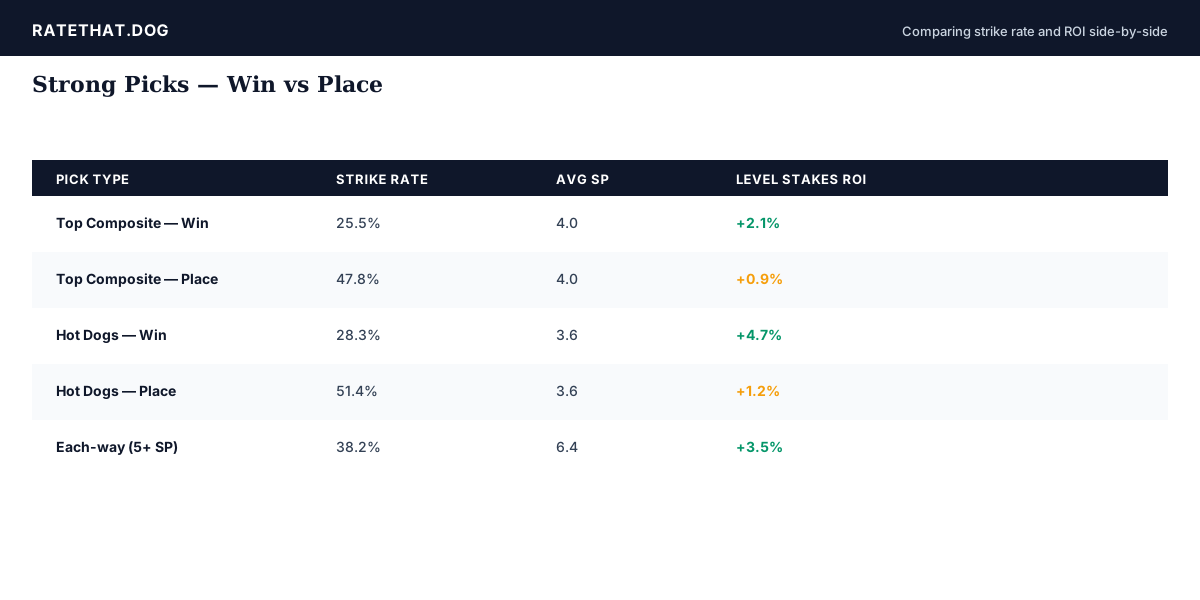
When the dog's win odds are 5.0+ and the place chance is meaningful. At those prices, the place payout (1/4 of SP) is large enough to matter, and the place strike rate adds enough hits to flatten variance.
The cleanest each-way candidates are 5.0-10.0 SP composite top picks where the model thinks the dog is a strong place chance even if it doesn't win. Below 5.0 SP, the place payout is so small (less than 1.0 unit return per unit staked) that it barely covers the place's loss frequency.
When does each-way cost you money?
When the dog is short-priced. A 2.5 SP dog backed each-way: if it wins, win pays 1.5, place pays 0.375 — total profit 1.875 on 2 units staked. If it places only, place pays 0.375 against a 1-unit win-bet loss — net loss of 0.625. The win-only approach earns more upside per unit risked.
Rule of thumb: under 4.0 SP, just bet to win. Above 4.0, each-way starts to be defensible. Above 6.0, each-way is often the smarter shape.
What's the simplest each-way strategy on greyhounds?
Pick composite top picks at 5.0+ SP and back them each-way. This filter naturally excludes the over-priced favourites where each-way maths fails, and naturally includes the dogs where the place upside is meaningful.
Save it as a system using the SP filter and the platform will track win, place and combined ROI separately. Most users find this approach delivers a steadier P&L curve than pure win-betting on the same picks.
Frequently asked questions
Is each-way betting good for greyhounds?
It depends on the price. Above 5.0 SP, each-way usually outperforms a pure win bet on variance-adjusted basis. Below 4.0 SP, win-only is better.
How is greyhound each-way calculated?
Stake split between win (full SP) and place (1/4 SP, paying for 1st or 2nd in a six-runner race). A £5 each-way is £10 total — £5 win, £5 place.
Can I do each-way bets on every greyhound race?
Yes. UK bookmakers offer each-way on standard six-runner greyhound races. Not all five-runner or smaller fields qualify for each-way at every bookmaker.
Is each-way better for high or low odds?
High odds. The 1/4 place payout is meaningful at 6.0+ SP and gets weaker as prices shorten. At 2.5 SP, the place portion barely earns enough to justify the doubled stake.
What's the typical each-way ROI on top picks?
Depends on the price filter. Each-way on composite top picks priced 5.0+ SP often returns flat-to-positive ROI with materially lower variance than the same picks backed to win.