
How to Read a Greyhound Racecard — A Beginner's Guide
Traps, ratings, suitability, form lines, RTD odds — a racecard looks like a spreadsheet until you know what each column means. Here's a walk-through using a real RateThatDog racecard, column by column.
A racecard is just a table — read it left to right
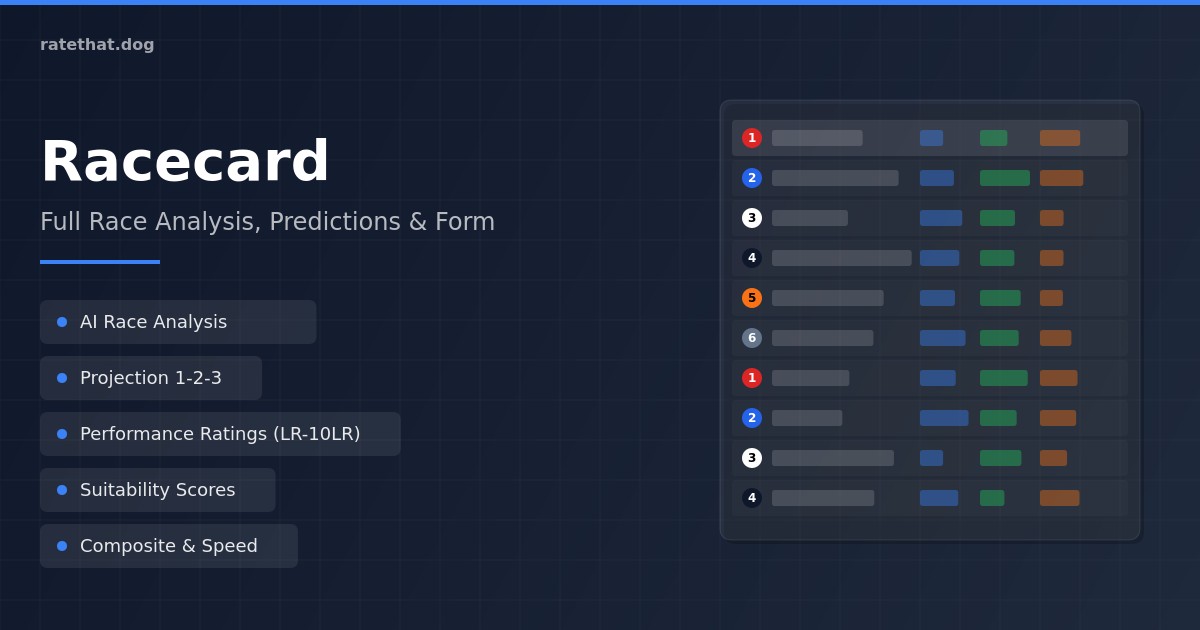
Six dogs, six rows, one race. Every column answers a specific question about that dog's chance.

Every racecard on ratethat.dog follows the same layout, whatever the track or distance. Down the left, one row per dog. Across the top, one column per stat. The trick to reading it quickly isn't memorising every number — it's knowing which handful of columns actually move the needle, and reading those first.
At the very top of the page, above the table, you'll see the **Model Projection** bar: a gold, silver and bronze pick for the race, worked out from everything in the table below. That's the shortcut. Everything underneath it is the evidence for why those three dogs were picked — useful once you want to check the model's working, or form your own view.
The first column, **Trap**, is the most important thing on the page and the easiest to miss. It's shown as a coloured badge (red 1, blue 2, white 3, black 4, orange 5, striped 6) matching the colours greyhounds actually wear in the race. Trap position affects a dog's chance more than almost anything else — some tracks have a strong inside (Trap 1/2) bias, others run flat. The track pages show you which is which for every UK and Irish venue.
Rated, Spd and Bnd — the three headline numbers
**Rated** is our Performance Rating, 0-100, built from pace, finishing position, beaten distance and how the dog's times have trended across recent races. Anything in the 60s or above is a genuinely strong recent performer for the grade; 30s and 40s is a dog that's either out of form or racing above itself.
**Spd** is Speed Rating, 0-120, where 100 is the median dog at that distance — a purely time-based number, stripped of where the dog finished. A dog can be modest on Rated but excellent on Spd if it's quick but keeps getting checked or baulked in running; that's exactly the kind of mismatch worth knowing about before you bet.
**Bnd** is bend speed — how fast the dog gets to the first bend relative to the field. It matters most at sprint trips and on tracks where the rail is a big advantage, because the dog that gets there first often controls the whole race.
Form lines, Suitability and the coloured cells

The block of numbers under **LR, 2LR, 3LR...** is the dog's last ten races, most recent first, each shown as that individual race's Performance Rating. The small number in brackets underneath is where that rating ranked within the field that day — a (1) means it was the best-rated dog in that race, win or lose. The colour shading (green = strong, red = weak) lets you spot a pattern — a dog trending from red to green across its last few starts is improving; the reverse is a dog going backwards.
**Suitability** breaks into four sub-scores — Trap, Track, Class and Dist — each 0-100, showing how well this specific dog's history matches this specific trap, this track, this grade and this distance. A dog can have a great overall rating but a poor Suitability score if it's stepping up in class or trying a new track for the first time; that combination is exactly the kind of thing the raw rating alone won't tell you.
**Form** is a simpler 0-100 read on recent form alone, weighted toward the last two or three runs. **Comp** is the composite score — our blended headline number that folds rating, suitability and speed together, weighted differently by distance (a sprint leans harder on raw rating; a standard-distance race leans harder on field speed). **Pred** is where our model ranks the dog in this specific race, 1 being top-rated. **RTD** is our estimate of fair odds for that dog, for comparing against the bookmaker's actual price.
Click a dog's name for the full story

Every dog's row expands (click the small triangle next to its name) into two things worth knowing about. First, a **Deep Reasoning Assessment** — a plain-English paragraph explaining the dog's chance, written the way a knowledgeable friend would talk you through it, not a wall of numbers. It typically covers early pace, recent form, trainer record, and the draw, then gives a one-line verdict.
Underneath that sit **Condition Fit** and **Weather Fit** boxes — quick notes on whether today's going and (where relevant) weather suit this dog's known preferences. These are the qualitative context the raw numbers above can't capture on their own — worth a glance on any dog you're seriously considering.
Last 10 Races — the raw form, race by race

Scroll further into the expanded row and you'll find the dog's actual race-by-race history — the same information a printed racecard from the track would give you, just laid out clearly. **Pos** is where it finished, **Btn** is the distance beaten by (or led by, if it won), **Adj Time** is its time adjusted for the going that day so times are comparable across different conditions, and **SP** is the starting price it went off at — useful for spotting whether the market has previously rated this dog higher or lower than our model does.
The **Comment** column is the track's own note on how the race unfolded for that dog — "early pace, rails, slightly crowded bend 1" tells you far more about what actually happened than the finishing position alone. A dog that got trapped behind traffic and still finished close up is often a better bet next time than the raw result suggests.
Putting it together: a 30-second read before you bet
You don't need to study every column on every dog. A quick, sensible routine: check the **Model Projection** medals at the top for the shortlist, glance at **Trap** for each of those three (is it a track where the draw matters?), compare their **Comp** and **Pred** ranks, then click into the top pick's **Deep Reasoning Assessment** to sanity-check the story behind the number.
If you want to go deeper before backing anything, the Dog Selector lets you filter every runner in every race by any of these columns at once — useful once you've got a feel for which numbers matter most to you. And if you'd rather have the analysis done for you, the free tips page publishes our top pick for every race with the reasoning already written out.
Frequently asked questions
What does the trap colour mean on a greyhound racecard?
It's the actual colour jacket the dog wears in the race — red (1), blue (2), white (3), black (4), orange (5), black-and-white stripes (6). It also tells you the dog's starting position, which matters a lot on tracks with a strong inside or outside bias.
What's the difference between Rated and Comp on a racecard?
Rated is the Performance Rating alone (pace, position, beaten distance, sectional trend). Comp is the composite score — a blend of rating, suitability and speed, weighted differently depending on the race distance. Comp is generally the better single number to sort by.
What does RTD mean on the racecard?
RTD is our model's estimate of fair odds for that dog — what the price 'should' be based on its rating and suitability. Comparing RTD to the bookmaker's actual price is one way to spot value.
What's the Deep Reasoning Assessment?
A plain-English written analysis for each runner, generated from the same underlying data as the ratings columns, but explained the way a knowledgeable tipster would talk you through a dog's chance rather than as raw numbers.
Do I need to understand every column to use a racecard?
No. The Model Projection medals at the top of every race are a ready-made shortlist. The columns are there for when you want to check the model's reasoning or dig into a specific dog yourself.