
Greyhound Grades Explained — A1 to A11, OR, D and P
Greyhound grades go from OR (Open Race) at the top to A11 and D4 at the bottom. Here's the full hierarchy in plain English, and what each grade tells you about the dogs running today.
What is a greyhound grade?
A grade is the class of a race — a label that tells you how good the dogs running are, relative to each other. Greyhound racing in the UK is graded by the Greyhound Board of Great Britain (GBGB) on every track, and the grade printed on the racecard is the single fastest way to gauge the standard of a race.
Higher-graded races contain better dogs. Better dogs are faster and more consistent, which makes form more reliable and the favourite more likely to win. Lower grades are messier, less predictable, and pay better odds when you're right. The model's Strong Picks list naturally skews towards the higher-grade races for that reason.
What is the greyhound grade hierarchy?
Hardest to easiest, the standard UK ladder runs:
- **OR** — Open Race. The elite category. Includes major competition heats and finals. The best dogs on the card.
- **A1 to A11** — the standard middle-distance grade ladder. A1 is the top mid-week class; A11 is the lowest before maidens.
- **D1 to D4** — sprint grades, used for short-distance races (typically 230-280m). D1 is the strongest sprinters; D4 is the weakest.
- **P** — Puppy. Reserved for young dogs (typically under 24 months) still building their form record.
- **T** — Trial. Not a competitive race; we exclude trials from analysis on ratethat.dog.
What does A1 mean in greyhound racing?
A1 is the top of the A-grade ladder for standard-distance races. An A1 race is contested by the best mid-week dogs at a given track — animals that have proven they can win consistently and run fast times. Form lines from A1 are the most reliable on the card.
If a dog steps up from A2 into A1 and stays competitive, that's a positive sign. If a dog drops from A1 to A3 over a few weeks, the trainer is usually trying to find a softer race to get a win back into the form figures.
What's the difference between A grades and D grades?
Distance. A grades are for standard middle-distance races (typically 380-500m). D grades are for sprint races (typically 230-280m). A dog rated A4 over 500m and D2 over 270m isn't necessarily inconsistent — it's just better suited to one distance than the other.
When you see a dog moving between distance categories, check its track-and-distance record. The Suitability rating on ratethat.dog tells you how well a dog has performed at the specific distance and track of today's race — which matters far more than its grade in the abstract.
How does grade affect my betting?
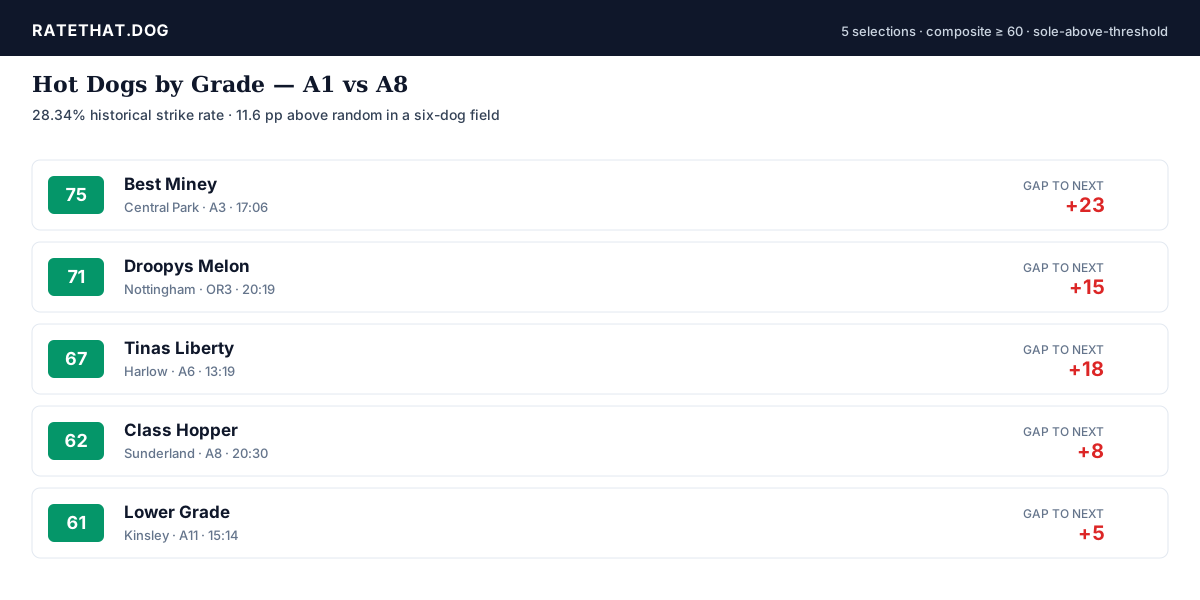
Two practical effects. First, favourites win more often in higher grades — the better dogs are more consistent, so the form lines you're reading are more predictive. Backing favourites blind isn't a strategy at any grade, but the model's top picks are stronger signals at A1-A3 than at A9-A11.
Second, lower grades pay better when you're right. Dogs in A8-A11 races are messier and the market is less efficient — meaning odds are wider, and a well-justified bet can return more. The trade-off: you have to be patient with the strike rate.
Should I focus on one grade when I'm starting?
Yes. Pick one grade band (we'd suggest A4-A6 for variety, or pure A1-A3 for cleanest form) and watch a few cards before mixing. You'll start to recognise which dogs are class-suited, which are dropping in grade for a reason, and which trainers do well at that level.
When you're ready to widen out, the Dog Selector lets you filter by grade and stack other criteria on top — speed, suitability, trainer form, trap. That's where focused grade knowledge starts to compound into edge.
Frequently asked questions
What is the highest greyhound grade in the UK?
OR — Open Race. These are the elite-class races, including major competition heats and finals. The dogs in OR races are the best on the card.
What's the lowest greyhound grade?
A11 for middle-distance races, D4 for sprints. These are the lowest competitive grades before maiden and trial categories.
Why does a dog drop in grade?
Usually because the trainer is trying to find a softer race for a winnable card. A dog losing at A3 might be entered at A6 to face weaker rivals and rebuild confidence.
Is an A1 dog faster than a D1 dog?
Not necessarily — A and D grade different distances. An A1 dog is the fastest at standard distance; a D1 dog is the fastest at sprint distance. Compare run times within the same distance band, not across A/D grades.
Why are trial races (T) excluded on ratethat.dog?
Trial races aren't competitive — they're solo runs for grading and qualification, not predictive of future race results. We strip them out of all analysis to keep form lines clean.